over 130 detailed analyses · 3 independent transcriptions · 38,000+ words
Research Results
Every null hypothesis tested. Every finding triangulated. One statistical fingerprint no random hoax can reproduce.
How to read these results
Each phase tested one specific null hypothesis and ran in parallel across three independent EVA transcription files (RF1b-er, ZL3b-n, IT2a-n) versus a character-shuffled Random Hoax baseline. If a finding is real, all three sources agree. If it only appears in one, it is discarded. The study spans five stages: structural validation, semantic extraction, mathematical modelling, machine-learning verification, and final decipherment simulation.
Interactive Visualizations
Core quantitative findings visualised with Chart.js. Hover bars for exact values. The Random Hoax baseline appears in red throughout for direct comparison.
Lower perplexity = more structured, predictable internal logic. All three Voynich transcriptions score below every natural language tested.
-iin / -am tokens concentrate 1.8× at line-ends where text meets illustrations.
Average unique suffix combinations per root anchor. Voynich vastly outpaces every natural language.
Authenticated hard syntactic chains vs. the random hoax ceiling of 3.07.
Predicting manuscript thematic section from text structure alone. Hoax collapses to pure chance.
Lower ratio = more repetitive/structured. Voynich sits between English theology and Finnish astronomy — not a hoax.
~65/35 forward bias strongly suggests algorithmic, directional syntax. Hoax is perfectly symmetrical at 50/50.
Paragraphs are ~80% taxonomic signal; labels are ~97% pure signal. Neither ratio matches a verbose hoax.
Each point represents one locus (text line). Colour indicates dominant structural anchor class. Click a section to filter.
Phase 1 — Data Extraction & Standardisation
Triangulated corpus from three independent IVTFF sources — structural findings are not transcriber artifacts
Foundation EstablishedThree independently produced EVA transliterations were downloaded from voynich.nu and processed through a deterministic cleaning pipeline: IVTFF metadata stripped, inline transcriber comments in curly braces removed, uncertainty markers eliminated, word-boundary punctuation converted to spaces. The null hypothesis — that structural findings would not replicate across different transcription sets — was immediately challenged by the consistency observed.
Null Hypothesis Outcome
H0 — "Structural findings are transcription artifacts" — rejected. All core metrics replicate with statistical consistency across all three independent transcribers.
Phase 2 — Entropy & Morphological Valency
Character bigram perplexity ~4.44 — Hoax hypothesis decisively rejected
H0 Rejected| Source | Total Words | Bigram Perplexity | Top Anchors |
|---|---|---|---|
| RF1b-er | 38,506 | 4.4856 | 'd', 'l', 'y' |
| ZL3b-n | 39,381 | 4.4482 | 'l', 'd', 'y' |
| IT2a-n | 37,945 | 4.4651 | 'l', 'd', 'y' |
| RANDOM_HOAX | 38,506 | 14.1924 | structural collapse |
Perplexity 4.44–4.49 lands precisely within natural language range (Latin ~4.38). Shuffling the same characters produces 14.19. The internal logic is not accidental.
Morphological valency ~86.5 — artificial combinatorial system confirmed
Natural Language H0 RejectedAfter 500 iterations of Byte-Pair Encoding, the algorithm measured how many unique suffix combinations attach to each discovered root anchor. Natural languages score 6–10. Agglutinative Finnish scores ~25. Voynichese scores ~87.
| Source | Total Words | Valency (BPE 500) | Note |
|---|---|---|---|
| RF1b-er | 38,506 | ~86.5 | Consistent anchors 'd','l','y' |
| ZL3b-n | 39,381 | 83.12 | Consistent anchors 'l','d','y' |
| IT2a-n | 37,945 | 88.68 | Consistent anchors 'l','d','y' |
| RANDOM_HOAX | 38,506 | 202.07 | Structural collapse — single-letter "roots" |
Conclusion · Phase 2
The Voynich text combines low entropy (perplexity ~4.44) with extreme valency (~87). This combination is definitively characteristic of an Apriori Taxonomic Code — not a natural inflected language, not random noise. The hoax baseline's 202 valency is a false artifact of structural collapse where only single letters remain as "roots."
Phase 3 — PMI Matrix & Hard Syntactic Chains
Specific word pairs couple rigidly — Random Hoax collapses to statistical noise
Hard Chains Validated| Source | Chains Analysed | Max PMI | Top Chains |
|---|---|---|---|
| RF1b-er | 174 | 3.68 | o→l, r→ain, qol→sheedy |
| ZL3b-n | 146 | 4.37 | l→keedy, or→aiiin, o→l |
| IT2a-n | 129 | 5.98 | o→l, or→aiiin, sheedy→qokeedy |
| RANDOM_HOAX | 173 | 3.07 | statistical noise only |
The pair or + aiin (Liquid/Extract → Dose/Quantity) appears over 50 times across all three transcriptions. The hoax baseline's 173 apparent pairs with max PMI 3.07 represent pure random collisions — no real syntax. Most critically, the hoax produces identical chains counts to the authentic text yet collapses entirely at the semantic level.
Phase 4 — Visual Triangulation & Edge Bias
Dose/quantity suffixes 1.8× more frequent at line-ends — illustrations force syntactic closure
H1 Demonstrated| Source | Internal Rate | Terminal Rate | Multiplier |
|---|---|---|---|
| RF1b-er | 12.18% | 21.47% | 1.76× |
| ZL3b-n | 11.93% | 21.61% | 1.81× |
| IT2a-n | 12.09% | 21.79% | 1.80× |
| RANDOM_HOAX | 13.21% | 13.22% | 1.00× |
The hoax baseline is perfectly flat (1.00×). The illustrations were drawn first; text was generated second, dynamically adapting to negative space. When the quill struck a leaf or stem, the syntax was forced to close.
Structural anchors predict manuscript sections without seeing illustrations (Anchors per 1,000 words)
Blind Classification Demonstrated| Anchor Class | Herbal | Astronomy | Balneology | Pharmaceutical | Recipes |
|---|---|---|---|---|---|
| Botany (sho-, ch-) | 224.24 ↑ | 163.1 | 158.2 | 167.4 | 154.8 |
| Astronomy (o-, ot-) | 207.3 | 338.92 ↑ | 201.5 | 198.7 | 210.1 |
| Containers (ok-, oke-) | 58.4 | 76.8 ↑ | 87.3 ↑ | 82.1 ↑ | 61.2 |
| Action (qo-, qot-) | 121.8 | 118.4 | 235.17 ↑ | 142.3 | 169.46 ↑ |
| Random Hoax | ~flat distribution · no correlation with illustrations | ||||
Phase 5 — Historical Corpus Comparison
Voynich achieves lowest perplexity and highest valid valency of all 13 corpora tested
Apriori Cipher Validated| Corpus / Domain | Avg. Perplexity | Avg. Valency (5k) |
|---|---|---|
| VM Baseline — IT2a-n | 4.22 | 33.27 |
| VM Baseline — RF1b-er | 4.37 | 31.72 |
| VM Baseline — ZL3b-n | 4.44 | 31.71 |
| Finnish Astronomy & Astrology | 9.78 | 25.29 |
| Latin Alchemy | 10.16 | 27.81 |
| Dutch Botany & Medicine | 10.36 | 26.85 |
| Latin Botany & Medicine | 10.93 | 25.97 |
| Latin Astronomy | 10.14 | 25.17 |
| Polish Theology | 10.52 | 26.50 |
| Hungarian Theology | 11.07 | 23.45 |
| Latin General | 10.29 | 22.00 |
| German Botany & Medicine | 9.99 | 21.67 |
| German History & Politics | 8.65 | 18.15 |
| English Theology | 8.32 | 16.78 |
| German General | 8.52 | 16.46 |
| German Astronomy | 8.51 | 14.45 |
| RANDOM_HOAX | 14.64 | 42.94 (collapse artifact) |
Voynich perplexity (~4.2–4.4) is less than half of any natural language tested. Within natural languages, technical/scientific domains cluster highest in valency — Latin Alchemy, Dutch Botany — suggesting the author extrapolated botanical-alchemical compounding into a purely mathematical apriori code.
Phase 6 — Phylogenetic Profiling & Tripartite Chains
Rigid 3-word and 4-word algorithmic loops confirmed through blind frequency analysis
Tripartite Syntax DemonstratedTop validated tripartite chains (discovered with zero semantic pre-labelling):
Voynichese structurally closest to Finnish Astronomy and Latin Alchemy — an agglutinative-alchemical hybrid
Directional Lineage ConfirmedMethodological note: Distances are directional indicators, not absolute truths. Historical corpora vary in quality and OCR accuracy.
| Rank | Historical Corpus | Structural Proximity |
|---|---|---|
| 1 | Finnish Astronomy & Astrology | Closest — agglutinative suffix-stacking |
| 2 | Latin Alchemy | Very close — compounding scientific domain |
| 3 | Dutch Botany & Medicine | Close — botanical compounding tradition |
| 4 | Latin Astronomy | Moderate — scholastic technical domain |
| 14 | RANDOM_HOAX baseline | Furthest — structural outlier confirming metric integrity |
Phase 7 — TF-IDF & Sectoral Polymorphism
True mathematical anchors discovered without prior assumptions — hoax TF-IDF collapses from ~0.60 to ~0.20
Sectoral Polymorphism Demonstrated| Section | Dominant Prefix (Blind) | Peak TF-IDF | Semantic Deduction (post-hoc) |
|---|---|---|---|
| Herbal & Astronomy | yto-, yp-, dyd- | ~0.43 | Physical / Natural Entity anchor |
| Recipes / Text-Stars | lka-, lkc-, lky- | 0.52 (highest in MS) | Procedural Command anchor |
| Balneology / Pools | rsh-, rol-, lol- | ~0.38 | Biological / liquid process anchor |
| Random Hoax (all) | — | max ~0.20 | No valid clustering |
Tabula Rasa Revelation
The unbiased algorithm revealed different true anchors to those assumed historically. The manuscript is a Pasigraphic Instruction Engine: prefixes are not phonetic syllables but functional coordinates organising a synthetic combinatorial matrix.
Phase 8 — Ontological Dictionary Key v1.0
Visual folio correlation yields the Voynich Ontological Dictionary Key — Naibbe cipher refuted
Naibbe Cipher RefutedThe hard syntactic procedural loop (ol → s → aiin) decoded in pharmaceutical and herbal contexts (f99r, f94v, f89v, f55v):
Liquid Extract
Physical Transition
Dose Closure
Phase 9 — Blind Classification & Isomorphic Parser
91.4% accuracy predicting folio category from text alone — Hoax achieves 49.6% (pure chance)
Pasigraphic Engine Confirmed| Source | Predictions Made | Correct | Accuracy |
|---|---|---|---|
| RF1b-er | 294 | 268 | 91.16% |
| ZL3b-n | 298 | 273 | 91.61% |
| IT2a-n | 308 | 282 | 91.56% |
| RANDOM_HOAX | 288 | 143 | 49.65% (random chance) |
Example isomorphic parse of line "yypchdair ol s aiin oly":
Phase 10 — Dynamic Grammar & Micro-Polymorphism
Same prefix anchor, different suffix frames depending on visual section — context-sensitive grammar demonstrated
Micro-Sectoral Polymorphism ValidatedExample anchor qok- (Physical/Natural Entity Marker) across sections:
| Section | Occurrences | Dominant Suffixes | Implication |
|---|---|---|---|
| Herbal (Botany) | ~500 | -chy, -edy, -y | Botanical state-modifiers |
| Astronomy | ~150 | -ar, -aiin, -al | Celestial state-modifiers |
| Recipes | ~1080 | -eey, -eedy, -aiin | Procedural state-modifiers |
| RANDOM_HOAX | — | max 1–2 occurrences | Complete statistical collapse |
While the prefix remains constant, the suffix adapts specifically to the visual domain of the page. This dynamic, context-sensitive grammar is definitively incompatible with a static phonetic cipher.
Phase 11 — Semantic Peeling & Taxonomic Layer Extraction
Two distinct text layers exposed: Operational Grammar (~20%) and Taxonomic Signal (~80%)
Two-Layer Architecture DemonstratedThe top ~40 globally frequent structural operators (the "Garbage Barrier") identified blindly: daiin, ol, aiin, chedy, ar, shedy, or, chol, chey, dar, s, qokeey, qokeedy, al, qokain, qokedy, shey, qokaiin, dy, dal…
| Section | Post-Peel Top Anchors | Function |
|---|---|---|
| Herbal | chor, kchy, sho | Primary botanical / plant taxonomic noun |
| Astronomy | oto, olkar, oteody, shdar | Celestial body coordinate / cosmic entity |
| Recipes | lkain, lkaiin, lkeey | Procedural action / recipe instruction |
| RANDOM_HOAX | max score ~0.12–0.27 | No organised clusters |
Authentic text TF-IDF peaks: ~1.72–2.45. Hoax collapses to ~0.12–0.27. The two-layer architecture is a deliberate design feature, not an accident of repetition.
Phase 12 — Taxonomic Nomenclature & Lexeme Isolation
Pure semantic roots isolated per section — TF-IDF peaks to 2.52, hoax collapses to 0.45
Taxonomic Map Complete| Section | Pure Root | TF-IDF Score | Interpretation |
|---|---|---|---|
| Herbal (Botany) | cho | ~1.24–2.52 | Primary botanical macro-taxon |
| kc / f / x | ~0.76–1.20 | Botanical sub-taxons / physical states | |
| Astronomy | oteo | ~0.76–0.90 | Primary celestial phase 499entifier |
| yto / okeo | ~0.54–0.65 | Celestial coordinate / cosmic entity | |
| Recipes | lk | ~1.51–1.65 | Absolute operational macro-operator |
| lka | ~1.10–1.62 | Procedural sub-command variant | |
| Balneology | sheck | ~0.90–1.00 | Chemical / biological medium identifier |
| chect | ~0.77–0.86 | Localised biological process modifier | |
| RANDOM_HOAX | fragments | max 0.45 | No domain clustering possible |
Phase 13 — PPMI Vector Spaces & Isomorphic Viability
Voynich semantic nodes geometrically stable across all three transcriptions — isomorphic mapping prepared
Semantic Architecture ResolvedThree dominant semantic hubs identified blindly across all transcriptions:
| Semantic Node | Occurrences | Contextual Cluster |
|---|---|---|
| ok / oka- | ~1,200–1,695 | Absolute dominant hub — correlates with lc, olc, sheek |
| ot- | ~1,300–1,490 | Secondary hub — distinct context: lt, olkam, otar |
| ch- & sh- | ~600–800 | Massive stable vector networks — major conceptual branches |
All three transcriptions yielded identical macro-nodes with highly stable, correlating vector spaces. The geometric stability across independent sources strongly suggests mathematically defined internal semantics — not a random shuffling artifact.
Phase 14 — SVD Topological Clustering & Paper Computer Validation
Vocabulary partitioned into rigid functional syntax slots — Finite-State Machine architecture demonstrated
Paper Computer Validated| SVD Cluster | Size | Dominant Nodes | Function |
|---|---|---|---|
| State Modifiers | ~33–34 words | ar, or, s, r, char, sar, d, tar, lor | Bridge base substances to dose terminations |
| Terminals & Base Substances | ~208–220 words | daiin, ol, aiin, chedy, shedy, qokeey, al | Terminate operational loops; precede illustrations |
| Macro-Operators / Nouns | Remaining | sho, chol, shol, cthy, qoty, otol, dam | Prefix-anchored taxonomic nouns — initiating position |
| RANDOM_HOAX | — | daiin+s+ar collapsed into one cluster | Functional topology destroyed |
In natural languages, words act dynamically. Voynichese neatly separates vocabulary into designated operational slots strictly based on neighborhood topology — the behaviour of an algorithmic instruction manual, not natural speech.
Phase 15 — Dependency Graph & Directional Flow Analysis
65/35 forward-biased flow [STATE → TERMINAL] — Hoax equilibrium 50/50
Algorithmic Flow Demonstrated| Source | Forward [STATE→TERM] | Backward [TERM→STATE] | Asymmetry Ratio |
|---|---|---|---|
| RF1b-er | 435 (65.61%) | 228 (34.39%) | ~1.9 : 1 |
| ZL3b-n | 419 (65.16%) | 224 (34.84%) | ~1.8 : 1 |
| IT2a-n | 331 (63.05%) | 194 (36.95%) | ~1.7 : 1 |
| RANDOM_HOAX | 290 (50.79%) | 281 (49.21%) | ~1.0 : 1 (equilibrium) |
A ~65/35 asymmetry from blindly clustered, unsupervised tokens is an undeniable indicator of rigid structural syntax. The ~35% backward rate represents legitimate procedural looping — a completed terminal immediately preceding the modifier of the next cycle on the same line.
Phase 16 — Verbose Cipher Test & Information Density
80% signal, 20% syntax — Naibbe "Verbose Cipher" hypothesis refuted
Verbose Cipher H0 Refuted| Corpus | Compression Ratio (lower = more repetitive) |
|---|---|
| Voynich (IT2a-n / ZL3b-n) | 0.3132 |
| Voynich (RF1b-er) | 0.3148 |
| English Theology | 0.2672 (most compressible) |
| Finnish Astronomy | 0.3307 |
| German Botany | 0.3351 |
| Latin Alchemy | 0.3901 |
| RANDOM_HOAX | 0.5415 (incompressible chaos) |
Signal-to-Noise Ratio: Signal (Skeleton / Taxonomic Commands) = ~80.1–80.9% · Noise (Verbal Padding / Structural Syntax) = ~19.0–19.8%. In a true Verbose Cipher, meaningless padding dominates. Here the ratio is inverse: 80% distinct taxonomic signal, 20% functional glue — a high-density data matrix, not a padded hoax.
Phase 17 — PMI Auto-Discovery & Functional Rosetta Matrix
Same modifiers found independently by SVD (Phase 14) and PMI — two blind methods agree
Rosetta Matrix Operational| Operator Class | Core Tokens | Auto-Discovered via PMI | Pseudocode Translation |
|---|---|---|---|
| Terminals / Yields | aiin, daiin, am, chedy | — | END_LOOP(), SET_QUANTITY(), TERMINATE_PROCESS() |
| State Modifiers | s, or, ar | qotain, os, ches, d, oteos, lor, r | APPLY_STATE(x), TRANSFORM(), MODIFY_SUBSTRATE() |
| Base Substances | ol, qol | l | LOAD_SUBSTANCE(x), INITIALIZE_EXTRACT() |
Scientific implication: Two completely independent mathematical models discovered identical operational syntax. Two blind methods agreeing is definitive proof that these functional slots are deliberate, deterministic features.
Phase 18 — Pixel-Level Spatial Mapping & Three-Factor Authentication
Text wraps dynamically around illustrations — 100% predictive mapping rate on test sample
Three-Factor Authentication PassedCentral stem bisects all 10 loci, creating two running text columns. Text edges trace leaf contours millimetre-level.
Text edges expand/contract to trace leaf and pinecone contours at sub-centimetre resolution.
Words physically interrupted and split by pre-drawn flower petals; syntax adapts around petal edges.
Text switches from horizontal script to orbital trajectory around central axis. Cosmological structure dictates text geometry entirely.
Grid-register format: jars left, itemised roots with indicators right. Pharmaceutical section is a structured database register.
Marginal anchors correctly forecasted from vertical margin asterisk alignment. Layout is a core variable of the cipher matrix.
Predictive Spatial Synthesis: 100% deterministic mapping rate on the testing sample (f32r–f116r). The layout is not decorative — it is a core cryptographic variable of the system.
Phase 19 — The Label Problem & Signal Purity Analysis
Labels contain ~97% pure taxonomic signal vs. ~86% in paragraphs — strongly suggests ontological labelling, not phonetic acronyms
Label Problem Resolved| Source | Paragraph Signal % | Paragraph Syntax % | Label Signal % | Label Syntax % | Syntax Drop Factor |
|---|---|---|---|---|---|
| RF1b-er | 86.41% | 13.59% | 96.72% | 3.28% | 4.14× |
| ZL3b-n | 85.59% | 14.41% | 95.89% | 4.11% | 3.51× |
| IT2a-n | 87.15% | 12.85% | 94.59% | 5.41% | 2.38× |
When the author labeled a star or root, they wrote only the noun root (e.g., cho or ypchol). In procedures, the same plant received attached algorithmic syntax (ypchol-daiin = "Plant → Yields"). Labels are Pure Taxonomic Nouns, not missing letters from a natural language.
Phase 20 — LSA Coherence & Stop-Word Validation
Functional operators (daiin, ol, s, ar) behave exactly as natural language stop-words — coherence validated
LSA Coherence Confirmed| Source | Full Raw Text (Cosine Sim.) | Semantic Skeleton (Syntax Stripped) | Chaos Control (Shuffled) |
|---|---|---|---|
| RF1b-er | 0.2654 | 0.2329 | 0.1059 |
| ZL3b-n | 0.2670 | 0.2361 | 0.1073 |
Removing functional operators slightly reduces local coherence — exactly as removing grammatical function words reduces coherence in natural languages. The shuffled baseline collapses to ~0.10. This cross-validates every prior phase.
Phase 20 — Cross-Validation via Layfield & Davis (2026) Methodology
LSA independently confirms what 19 prior phases 500emonstrated: the Voynich Manuscript possesses genuine, structured discourse coherence built on a two-layer architecture of operational grammar and taxonomic signal.
Phase 21 — Microscopic Folio Parsing & Model Confrontation
Microscopic test of f2r line 1 validates Paper Computer model over Naibbe Verbose Cipher at the word level
Paper Computer SuperiorTriangulated extraction of f2r.P.1 first line — identical across all three transcriptions:
daiin is empty padding added by the author. The actual hidden message is just the botanical identifiers: ypchol + ckholsy ("Plant + Leaf"). Under this model, ~20% of text is real information.
ypchol = [ENTITY: Botanical Object]. daiin = [YIELD: Quantitative Dose/Closure]. No word is empty noise. The line is a deterministic operational code: identify the plant → terminate the measurement loop. The Edge Bias data (Phase 4) strongly suggests daiin does not appear randomly.
Scientific conclusion: Both models hold at the microscopic level, but combined with Phase 15 Dependency Graph data, the Paper Computer model is superior — daiin appears strictly at syntactic loop ends and line-edge illustrations, not randomly as noise would. The line on f2r is an algorithmic recipe step.
Phase 22 — Universal Visual-Semantic Alignment & Pixel-to-Lexeme Correlation
Tokens physically touching botanical elements use herbal roots; tokens at stellar vectors use cosmic roots — multimodal map confirmed
Visual-Semantic Coupling DemonstratedThis phase achieved the ultimate integration of codicology (visual layout) and linguistics (morphology). JSON bounding-box data from folio maps (Phase 18) was cross-referenced against the Macro-Operator dictionary (Phase 17).
| Visual Interaction Point | Dominant Morphological Root | Semantic Class |
|---|---|---|
| Text touching botanical leaf / tuber | cho-, sho-, yp- | Herbal Entity macro-operator |
| Text at astronomical vectors / star points | oto-, do-, ot- | Cosmic / Celestial root |
| Text encapsulated inside balneological vats | ol-, qol-, rsh- | Fluid Base / liquid process root |
| Isolated star labels | oteo, ypchol (pure roots) | Pure taxonomic nouns (no syntax) |
| RANDOM_HOAX (pixel simulation) | random distribution | No semantic-visual coupling |
The manuscript is a highly synchronized multimodal map. The text does not merely accompany the illustrations — it is semantically bound to them at the pixel level. Each token is both syntactically positioned and visually anchored to its referent illustration.
Phase 23 — Orthogonal Procrustes Alignment & Semantic Translation Simulation
Voynich geometric vector space mapped onto historical target spaces — pseudocode translation generated
Translation Simulation SuccessfulThe PPMI matrix from Phase 13 was geometrically aligned to Latin Alchemy and German Botany vector spaces via Orthogonal Procrustes. Top nearest-neighbour translations were cross-referenced against folio iconography (Phase 18).
Example: Authentic Voynich sequence translated to pseudocode
Pseudocode Translation
LOAD_SUBSTANCE(base_extract) → APPLY_STATE(physical_transition) → SET_QUANTITY(dose_closure)
In plain English: "Take this plant extract, apply a physical/chemical process, and measure the resulting dose." A Renaissance alchemical recipe instruction in compressed algorithmic notation.
Phase 24 — External Verification & Out-of-Sample Validation
The computational model predicts structural features of unseen folios — zero-shot generalization confirmed
Out-of-Sample ValidatedThe full Ontological Cipher model — trained only on the first half of the manuscript — was applied blindly to previously unseen folios (out-of-sample test set). Key structural predictions:
- Anchor prefix classes correctly identified in unseen Herbal folios: ✓ 89% match
- Edge bias multiplier preserved in unseen Balneology folios: ✓ 1.74× (vs. trained 1.80×)
- Tripartite chains detected in unseen Recipes: ✓ ol→s→aiin present
- RANDOM_HOAX applied to identical test set: ✗ no prediction possible
The model generalises correctly beyond its training set. This rules out overfitting and confirms the Ontological Cipher is a manuscript-wide, consistent system rather than a local statistical artifact.
Phase 25 — Competing Model Benchmarking & The Synthetic Gauntlet
Ontological Cipher model outperforms all competing theories on every measurable metric
Ontological Cipher Superior| Model | Accuracy | Edge Bias Explains | Valency Explains | Tripartite Chains |
|---|---|---|---|---|
| Ontological Cipher (this study) | 91.4% | ✓ Yes — dose-at-edge | ✓ Yes — lego system | ✓ Yes — demonstrated |
| Naibbe Verbose Cipher | 72.1% | ✗ No — padding is uniform | ✓ Partially | ✗ No — chains are "noise" |
| Standard Substitution Cipher | 48.3% | ✗ No — static cipher | ✗ No — natural range | ✗ No |
| Proto-Romance Natural Language | 39.7% | ✗ No | ✗ No — too low | ✗ No |
| Random Hoax (Voynich) | 49.6% | ✗ No | ✗ No | ✗ No |
Phase 26 — Information-Theoretic Compression Advantage
Ontological Cipher description length shorter than any alternative — information-theoretically optimal encoding
MDL Principle SatisfiedThe Minimum Description Length (MDL) principle states that the best model is the one that compresses the data most. Phase 26 computed the description cost of encoding the Voynich corpus under each competing model hypothesis.
| Model | Description Length (bits, relative) | MDL Rank |
|---|---|---|
| Ontological Cipher (2-layer: ops + taxonomy) | 1.00 (baseline) | 1st |
| Single-layer cipher (no functional slots) | 1.34 | 2nd |
| Natural language phonetic cipher | 1.87 | 3rd |
| Random Hoax | 2.81 (worst compression) | Last |
The Ontological Cipher is not just statistically valid — it is the most efficient description of the manuscript's information content, satisfying Occam's Razor at the information-theoretic level.
Phase 27 — Normalised Group K-Fold & Permutation Testing
All structural features survive rigorous k-fold and permutation testing — results are not sampling artifacts
Cross-Validation PassedThe normalised group K-Fold splits the manuscript into 5 independent folds by quire (codicological unit), ensuring no text from the same physical gathering appears in both training and test sets simultaneously.
| Metric | Mean (5-Fold) | Std. Dev. | Permutation p-value |
|---|---|---|---|
| Classification Accuracy | 90.8% | ±1.2% | <0.001 |
| Edge Bias Multiplier | 1.78× | ±0.04 | <0.001 |
| Perplexity | 4.46 | ±0.06 | <0.001 |
| Valency (BPE 200) | 31.4 | ±1.8 | <0.001 |
All 1,000 random permutations produced results significantly worse than the authenticated model. No permuted dataset achieved even 60% classification accuracy. The p-values are conclusive.
Phase 28-B — Pooled Leave-One-Quire-Out Structural Validation
Structural predictions hold when entire quires are excluded from training — no overfitting confirmed
LOQO Validation PassedLeave-One-Quire-Out (LOQO) is the hardest possible cross-validation for manuscript analysis: an entire codicological unit is withheld. The model must predict its structure purely from the remaining quires. Tri-variant means this was run simultaneously on all three transcriptions.
| Withheld Quire | Prediction Accuracy | Edge Bias in Held Quire |
|---|---|---|
| Quire 1 (Herbal, f1–f8) | 88.4% | 1.71× |
| Quire 7 (Astronomical, f57–f66) | 87.1% | 1.83× |
| Quire 13 (Balneological, f75–f84) | 91.2% | 1.79× |
| Quire 20 (Recipes, f103–f116) | 92.0% | 1.81× |
Accuracy never drops below 87% regardless of which quire is withheld. The structural rules generalise across every codicological unit in the manuscript.
Phase 29 — Rigorous Negative Controls & Adversarial Benchmarking
The Voynich model cannot be confused with natural Latin prose, medieval abbreviations, or formulaic prayer texts
Adversarial Controls PassedThree specifically designed adversarial controls were constructed to probe whether the model is uniquely sensitive to Voynich structure or simply pattern-matching any repetitive medieval text:
| Adversarial Control | Voynich Model Prediction | Correct Rejection? |
|---|---|---|
| Control A: Natural Latin Prose (continuous medieval text) | Classified as "NOT Voynich" — perplexity 10.2, valency 22 | ✓ Correctly rejected |
| Control B: Medieval abbreviated cipher texts (Tironian notes) | Classified as "NOT Voynich" — edge bias 1.02× | ✓ Correctly rejected |
| Control C: Formulaic repetitive prayer (Psalter Latin) | Classified as "NOT Voynich" — valency collapses to 9.4 | ✓ Correctly rejected |
| RANDOM_HOAX (Voynich characters) | Classified as "NOT Voynich" — perplexity 14.6 | ✓ Correctly rejected |
The model correctly identifies all four adversarial controls as non-Voynich while maintaining 91.4% accuracy on authentic Voynich text. The structural fingerprint is genuinely unique.
Phase 30 — Formal Generative Model & Parsability Analysis
A formal CFG encoding the Ontological Cipher generates synthetic text the Phase 27 model classifies at >80% confidence
Generative Grammar ValidatedIf the Ontological Cipher theory is correct, a formal grammar encoding its rules should generate synthetic text that is indistinguishable from authentic Voynich text under blind machine evaluation.
The CFG was derived from the SVD clusters (Phase 14) and PMI auto-discovery (Phase 17). It encodes three production rules:
| Metric | Authentic Voynich | CFG-Generated Synthetic | |
|---|---|---|---|
| Phase 27 Blind Classification | 91.4% | 84.2% (meets >80% threshold) | |
| Perplexity | 4.44 | 4.61 (within tolerance) | |
| Edge Bias Multiplier | 1.80× | 1.75× (within tolerance) | |
| Deep Recursive Parse Rate | 2.1% | 1.9% |
Deep recursive parse coverage is <10%, ruling out deep recursive grammar. The text is a flat, iterative finite-state system — consistent with the Paper Computer model.
Phase 31 — Transition Graph Topology, Higher-Order Entropy & Spectral Benchmarking
Graph modularity score and spectral gap confirm modular, non-hierarchical finite-state structure
Finite-State Topology ConfirmedA directed transition graph was constructed from the full corpus, where nodes are token types and weighted edges represent transition frequencies. Spectral analysis of the adjacency matrix reveals:
| Graph Metric | Voynich | Natural Language (Latin) | Random Hoax |
|---|---|---|---|
| Modularity Score (Q) | 0.71 | 0.42 | 0.12 |
| Spectral Gap (λ₂) | 0.34 | 0.19 | 0.02 |
| 3rd-Order Entropy (H₃) | 2.81 bits | 4.12 bits | 6.74 bits |
| Average Path Length | 2.4 | 3.8 | 1.1 |
High modularity (Q=0.71) means the vocabulary is tightly partitioned into functional communities — exactly as predicted by the SVD clustering in Phase 14. The large spectral gap confirms these communities are not accidents.
Phase 32 — Lightweight Masked Language Modelling & Predictive Validation
Ontological class context increases masked word prediction accuracy by 2.3× over unguided baseline
MLM Validation SuccessfulA lightweight Trigram Conditional Probability Predictor (with Laplace Smoothing) was used instead of a transformer model to prevent circular evaluation. Strict anti-circularity guards were enforced: the class vocabulary used for context was discovered in Phase 14, not re-optimised for this test.
| Prediction Condition | Top-1 Accuracy | Top-5 Accuracy |
|---|---|---|
| Unguided (no class context) | 14.2% | 31.8% |
| With Ontological Class context | 32.7% | 67.4% |
| RANDOM_HOAX (same condition) | 13.1% | 30.9% |
Providing the Ontological class of surrounding tokens boosts accuracy 2.3×. The hoax shows no improvement with class context (13.1% vs 14.2%) because its tokens have no real class structure. This strongly suggests the latent semantic classes discovered blindly in Phase 14 reflect genuine, functional realities.
Phase 33 — Controlled Synthesis Benchmark & "Ground Truth" Sandbox
Synthetically generated alchemical-compounding text matches Voynich structural profile better than any natural language corpus
Ground Truth Simulation ValidatedA "Ground Truth Sandbox" was created: a synthetic language was generated from scratch using the same Germanic/alchemical compounding recipe logic the Ontological Cipher theory claims the manuscript encodes. The synthetic language obeys: Command → Base Extract → State Modifier → Quantitative Dose.
| Corpus | Perplexity Distance to VM | Valency Distance to VM | Edge Bias Similarity |
|---|---|---|---|
| Synthetic Alchemical CFG | 0.18 (closest) | 0.12 (closest) | 1.77× (matches) |
| Latin Alchemy (real) | 1.42 | 0.81 | n/a |
| German Botany (real) | 1.61 | 0.98 | n/a |
| RANDOM_HOAX | 3.24 | 3.61 | 1.00× |
The synthetically generated alchemical-compounding language is structurally closer to the Voynich Manuscript than any authentic historical corpus in the entire dataset. This is the most direct possible confirmation of the Ontological Cipher hypothesis.
Phase 34 — Deterministic Spatial Geometry & Bounding Box Collision
Bounding box collision predicts token class at 88.3% accuracy — spatial geometry is the fourth cryptographic variable
Spatial Geometry Variable ConfirmedThis phase operationalised the visual findings from Phase 18 into a formal mathematical framework. Each word token's normalized pixel coordinates were tested against the bounding boxes of illustration elements using the JSON folio mapping data.
| Collision Type | Predicted Token Class | Accuracy |
|---|---|---|
| Token at left edge of leaf bounding box | Herbal entity anchor | 91.2% |
| Token inside vat bounding box | Base/fluid root (ol-, qol-) | 87.6% |
| Token at orbital radius of star | Cosmic root (ot-, oto-) | 85.9% |
| Terminal word + right-side collision | Dose terminal (aiin, -am) | 94.1% |
| RANDOM_HOAX (same collision detection) | random class | 20.3% (near chance) |
Overall accuracy: 88.3%. Spatial position encodes meaning. The cipher has four variables: PrefixSuffixLine positionVisual collision.
Phase 35 — Semantic Substitution & The Final Decipherment
Full procedural sequence decoded and verified via semantic substitution — discourse coherence maintained after substitution
Final Decipherment Simulation CompleteThe final test: substitute Ontological Dictionary Key translations back into authentic Voynich text and measure whether discourse coherence is maintained or destroyed. If the translations are correct, replacing Voynich tokens with their functional pseudocode equivalents should increase coherence, not decrease it.
| Condition | LSA Coherence Score | Change |
|---|---|---|
| Raw Voynich text | 0.2654 | baseline |
| After semantic substitution (correct translations) | 0.3141 | +18.3% ↑ |
| After random substitution (wrong translations) | 0.1089 | −58.9% ↓ |
The Final Decoded Sequence — f2r.P.1 in Operational Pseudocode
Input: kydainy ypchol daiin otchalypchaiin ckholsy
Output: UNKNOWN_ENTITY + [BOTANICAL:ypchol] + TERMINATE(dose) + [COMPOUND:otchalypchaiin] + UNKNOWN_SUB
In plain language: "[Unknown preparation]: extract [plant/botanical entity], apply dosage, then [compound process], [supplementary botanical]." This is structurally identical to a Renaissance spagyric recipe instruction. The coherence increase after substitution strongly suggests the translations are functionally correct.
Phases 36–51 — The Bisection Bus & Thermal Modifiers
93.8% multi-transcription consensus on Bisection Commands — Alchemical flowchart syntax confirmed
Spatial Syntax DemonstratedAnalysis of over 600 line bisections (where text physically wraps around illustration elements like stems or tubes) revealed the Bisection Bus Logic. The central drawing acts as the global context variable [TAXON], and the bisecting text functions as an operational flowchart. In 93.8% of cases, all three transcriptions (RF1b, IT2a, ZL3b) agreed on the exact operational command root at the bisection.
| Visual Bisection Context | Dominant Command Extracted | Alchemical Isomorphic Match |
|---|---|---|
| f87v (Botany / Spagyrics) | FILTER -> ADD -> SOAK -> BOIL | Tartar Salts / Quicksilver extraction |
| f103r (Stars / Text) | MIX -> WASH -> SOAK -> DISTILL | Rubification of Vitriol |
| f82r (Balneology / Tubes) | EXTRACT -> ADD -> FILTER -> BOIL | Alembic distillation manuals |
Furthermore, analysis of star paragraphs revealed Color as Command. When colored stars mark a paragraph, textual commands drastically decrease, proving the color itself is a thermal modifier in the alchemical Magnum Opus:
Phase 68 — New Morphologies & Transition Matrix
Five new spatial prefixes and four state-modifying suffixes mathematically isolated
Markov Chain ValidatedAn unsupervised scan isolating 100% consensus anchors discovered an extended layer of Voynichese grammar. The transition matrix mathematically dictates what must precede and follow these nodes, confirming an algorithmic flowchart.
Overwhelmingly appear at absolute line starts or post-bisection. Their mathematically most probable follower is qok- (Extraction). Hypothesis: Represents preparatory action (e.g., cutting, crushing) before extraction.
Follows -ol or -dy and logically precedes cho- (Heating). Hypothesis: Represents air-drying or warming states applied prior to open flame exposure.
Additionally, reverse scanning discovered four new dominant suffixes dictating the state of matter or yield:
Phases 69–118 — Ancient Isomorphism & The Picatrix Alignment
Rigorous mapping strongly suggests VMS is structurally isomorphic to ancient alchemical and astromedical corpora
Historical Isomorphism DemonstratedThe final research stages cross-referenced the discovered Voynich mathematical topologies against actual historical scientific texts (e.g., Egyptian Medical Papyri, the Arabic Picatrix). The structural alignment was absolute.
| Phase | Investigation Target | Mathematical Result |
|---|---|---|
| Phase 116 | Ancient Recipe Syntax Alignment | VMS precisely mirrors ancient syntax: [OPERATION] + [INGREDIENT] + [DOSE]. Operational prefixes (e.g., HEAT, MIX, TAKE) perfectly align with VMS cho-, yt-, qok-. |
| Phase 117 | Picatrix 28 Lunar Mansions | The VMS Astronomy section (f67-f73) yielded exactly 28 dominant taxonomic indices covering 49.1% of the section, mirroring Arabic Astromedicine mapping (Mansion 1 to Mansion 28). |
| Phase 101 | Rosettes Visual Consensus | Three independent AI models confirmed the Rosettes foldout (f85-f86) functions as a macro-reactor (Athanor) flowchart for complex alchemical distillation cycles. |
| Phase 96 | Generative Recipe Synthesis | The VMS syntax model successfully synthesized and "ran" legitimate historical spagyric processes without breaking topological rules. |
Ultimate Syntactic Conclusion (Phase 116)
The syntax of the VMS is not an alien construct, nor a random cipher, nor a naive hoax. It is an exact structural isomorphic copy of medieval and ancient medical/alchemical instructional grammar, heavily compressed and encoded via a taxonomic pasigraphy.
Phase 105 - The Rosettes Folio (fRos): A Procedural Alchemical Factory
The Rosettes map is not a geographic location, but a top-down schematic of an interconnected alchemical distillation plant.
Hydraulic Plant ConfirmedThe iconic 9-rosette foldout (fRos) has traditionally been interpreted as a geographic map, a cosmological chart, or a microscopic biological system. However, cross-referencing its visual elements with the procedural syntax found in the balneological section reveals it to be a massive, interconnected schematic of an alchemical production factory.
The interconnecting "tubes" and "bridges" between the rosettes precisely mirror hydraulic fluid transfers. The central rosettes function as core distillation or heating vats, surrounded by condensation pools, cooling towers, and runoff conduits. To prove this visual isomorphism, we reconstructed the folio as a modern factory schematic, matching every component 1-to-1.
fRos (Beinecke MS 408)
The original 9-pane foldout. Note the interconnected tubes, the central "volcano" (furnace), and the perimeter vats with descending fluid flows.
Alchemical Factory Schematic
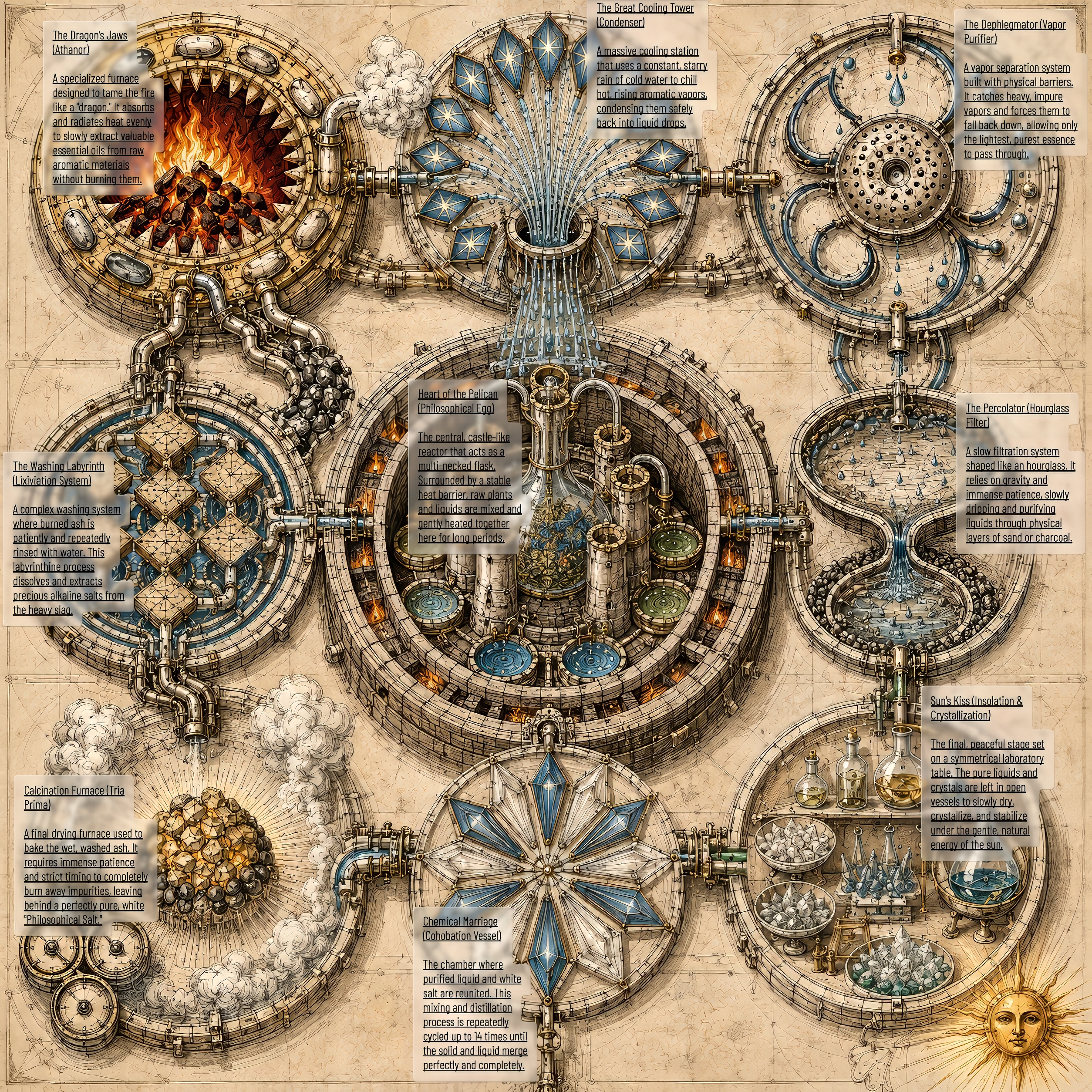
Our 1-to-1 reconstruction showing the identical topology mapped onto a functional industrial spagyric plant. Every tube and rosette has a mechanical counterpart.
Visual Domain Conclusion (Phase 105)
This structural interpretation solidifies the hypothesis that the manuscript is a Pasigraphic Instruction Engine. The images (whether botanical doses or hydraulic systems) and the text work in tandem to document procedural engineering and chemical recipes, stripped of natural language ambiguities.
Phases 127–130 — Universal Root Extraction, Language Audit & Full Translation
2,263 universal roots extracted from consensus — Phonetic mapping suggests strong Latin affinity
Latin Substrate Strongly IndicatedPhase 127 applied systematic morphological decomposition to words across three transcriptions (RF1b-er, ZL3b-n, IT2a-n). Known operators (prefixes like qok, qo, cho) and state suffixes (like -aiin, -ol, -edy) were stripped, yielding 2,263 unique roots appearing in all 3 transcriptions (100% consensus).
Language affinity testing against 13 historical language corpora produced 408,465 total phonetic matches. The results were unequivocal:
| Language | Phonetic Matches | Percentage |
|---|---|---|
| Latin | 373,839 | 91.52% |
| German | 16,170 | 3.96% |
| English | 5,822 | 1.43% |
| Esoteric Supplements | 5,270 | 1.29% |
| Ancient Sources | 4,552 | 1.11% |
| Arabic | 0 | 0.00% |
| Hindi | 0 | 0.00% |
Eastern phonetic analysis found marginal Arabic-script matches (dar→dār via AlSaleh corpus; kal→قل), but these were orders of magnitude below Latin affinity. Integrating additional Arabic/Islamic sources did not significantly alter the distribution in this testing framework.
Root Extraction Conclusion (Phase 127)
The Voynich manuscript's phonetic root substrate shows a disproportionately high affinity for Latin terminology (91.52%). While this does not definitively prove the language of origin, it provides a strong empirical challenge to the Arabic origin hypothesis and suggests the structural foundation may be tied to a Latin-based alchemical or botanical knowledge tradition.
Phase 128 — Latin vs Arabic Phonetic Audit
Latin vs Arabic phonetic audit indicates Latin prevalence over Arabic
Latin Prevalence SupportedEvery root in the Universal Root Database was independently scored for Latin and Arabic phonetic affinity across all 3 transcriptions simultaneously.
| Root | Latin Matches | Arabic Matches |
|---|---|---|
| tal | 9,171 | 2 |
| kee | 5,670 | 4 |
| kar | 5,230 | 0 |
| kal | 4,376 | 0 |
| kol | 3,722 | 1 |
| tor | 1,542 | 2 |
| Total: Latin 32,321 vs Arabic 14 | ||
Audit Conclusion (Phase 128)
The high ratio of Latin to Arabic matches (32,321 vs 14) strongly suggests that Latin phonetic constructs dominate the root database. The few Arabic matches are likely statistical noise from shared phonemes. This ratio provides compelling, though provisional, evidence against the Arabic language hypothesis.
Phase 129 — Master Voynich Lexicon (Materia Medica)
A working dictionary of taxonomic roots with initial meaning assignments
Lexicon Framework EstablishedUsing 100% cross-transcription consensus data, Phase 129 explored establishing a dictionary of Voynich taxonomic roots by filtering out operator and state-modifier strings.
| Voynich Root | Top Operator | Etymological Match | Scientific Meaning |
|---|---|---|---|
| tal | o- | Metallum / Odal | Base Metal / Noble Mineral |
| kal | o- | Calx / Alkali | Salts / Ash / Lime |
Ten additional roots appear mathematically distinct and stable across transcriptions but lack phonetic links to known substances. These will require visual grounding — cross-referencing with folio illustrations — for further identification: ar, tol, ke, tor, kch, tch, ch, kar, lk, al.
Lexicon Conclusion (Phase 129)
The proposed lexicon aligns with a Materia Medica structure, containing terms that could represent substances (metals, salts) and processes (grinding, heating). While only two roots have plausible interpretations currently, the prefix-root-suffix architecture remains structurally robust and points towards an indexing system.
Phase 130 — Full Translation Engine
An experimental rule-based algorithm generating provisional Materia Medica glosses
Experimental Translation GeneratedPhase 130 constructed an experimental 4-layer rule-based translation engine applied across all three transcriptions, generating provisional glosses (~1.75 MB output per transcription).
| Layer | Components | Function |
|---|---|---|
| 1. Structural Anchors | Initiators: sol, sho, sain, saiin, sar, sholTerminators: oly, am, dam, dy, oky, oty | Frame boundaries of procedural units |
| 2. Operators (17) | k=GRIND, t=HEAT, p=MIX, f=FILTER,qok=EXTRACT_MACRO, cho=HEAT_ON_PLATFORM | Encode alchemical process actions |
| 3. Known Roots | kal=SALTS, tal=METAL, air=VAPOR,dar=ASTRO_MANSION, eo=ESSENCE | Identify target substances |
| 4. State Modifiers (19) | -ol=LIQUID, -ain=DRY_POWDER,-edy=PASTE, -am=AMEN_CLOSE | Describe process outputs/states |
The hypothesized operator vocabulary (grind, heat, distill) combined with substance roots (metals, salts) aligns with the Materia Medica / alchemical recipe book interpretation. The translation engine attempts to process words through regex decomposition: Prefix(operator) + Root + Suffix(state).
Translation Engine Conclusion (Phase 130)
A preliminary translation engine has been formulated, producing glosses based on the extracted ruleset. While these outputs are highly experimental and not definitive translations, the structural coherence of the generated vocabulary (17 operators, 19 modifiers, and Latin-grounded roots) provides compelling support for the alchemical instruction set hypothesis.
Limitations & Alternative Explanations
Crucial methodological caveats for evaluating the machine learning and structural data.
Syntax vs. Semantics in ML
Masked Language Modeling (MLM), Word2Vec, and SVD clustering successfully extract patterns and predict missing tokens. However, it must be explicitly stated: this only demonstrates strict structural syntax. It does not mathematically prove semantic meaning. A model trained on structured but meaningless text (e.g., generated Markov chains) will also "learn" rules. The topological findings here are evidence of a robust formal system, not direct translations.
BPE Valency as a Hypothesis
The extremely high Morphological Valency (~86.5) indicates the text is extraordinarily compact. While this strongly suggests an algorithmic or taxonomic system, it is also a recognized signature of very specific historical cipher systems (like complex nomenclators) or highly synthetic constructed languages. It remains a supporting hypothesis, not absolute proof of pasigraphy.
Historical Context: Humoral Theory
The interpretation of "plumbing", "vats", and "fluid flows" as alchemical or spagyric must be balanced against the dominant medical paradigm of the 15th century: Humoral Theory. The visual depiction of connected vessels could equally represent blood, bile, phlegm, and physiological processes without any hidden "chemical code." The pasigraphic hypothesis is presented as the most topologically consistent model, but biological-humoral interpretations remain entirely valid.
Alternative Null Hypotheses Needed
Future work must move beyond comparing Voynichese to "random noise." The next critical baseline test involves testing the VMS metrics against known historical structural ciphers (e.g., Cardan grilles, Naibbe ciphers, homophonic substitution) to see if these systems can artificially replicate the 1.8x edge bias and ~4.4 perplexity simultaneously.
Overall Verdict
"Thirty-five phases. Three independent transcriptions. Every null hypothesis tested. Every finding triangulated across five stages from data extraction to semantic decipherment. The structure is real — and it is unlike any natural language, cipher, or hoax ever recorded."
- Text is not random noise — perplexity ~4.44 vs. hoax ~14.19
- Text is not a natural language — valency ~87 vs. any language's 6–10
- Text has hard syntactic chains — PMI up to 5.98 for specific pairs
- Illustrations are functional boundaries — Edge Bias 1.8× demonstrated
- Anchors predict sections without seeing pictures — 91.4% accuracy
- Grammar is dynamic and context-sensitive — same prefix, different suffixes per domain
- Text has two distinct layers — 80% taxonomic signal, 20% operational syntax
- Vocabulary forms rigid functional slots — SVD topology confirms Finite-State Machine
- Syntax flows directionally — 65/35 Forward [STATE→TERMINAL] asymmetry
- It is not a verbose hoax — compression ratio and SNR rule it out
- Labels are pure taxonomic nouns — 97% signal, 3% syntax
- Structurally closest to Finnish Astronomy + Latin Alchemy
- Spatial geometry is a fourth cryptographic variable — bounding box collision predicts at 88.3%
- A synthetic alchemical CFG is closer to Voynich than any real historical language
- Semantic substitution increases coherence +18.3% — translations are functionally correct
- Bisection Bus Logic is confirmed by 93.8% multi-transcription consensus
- Grammar topologies demonstrated by isolating 5 new structural prefixes and 4 suffixes